
Quick disclosure before you read another word: nobody mentioned in this piece, Core Peptides included, paid for this or got a preview copy. There’s no shopping cart anywhere on this page. Every claim below traces back to something public you can check yourself, FDA enforcement letters, PubMed-indexed human trials, and StatPearls reference monographs. Anything here that’s compounded or prescription-only has not been approved by the FDA as a finished drug. Anything sold “for research use only” has not been cleared for a human being to inject. Last reviewed June 2026.
I do consumer research for a living, which mostly means I get suspicious of anything that looks like a shortcut. So when I started pulling apart “peptide vendor” searches, I treated it the way I’d treat any other purchase decision: what am I actually being sold, who’s accountable if it goes wrong, and what does the fine print actually say versus what it implies.
Here’s what I came away with, and it’s not subtle. If you’re new to this, don’t shop research-chemical stores against each other on price or shipping speed. That’s comparing the wrong things. The question that actually protects you is supervised versus unsupervised, full stop, and unsupervised is where every research-chemical retailer lives, Core Peptides included.
My shortlist, in order: FormBlends at #1, HealthRX.com at #2. Everything else on the research-chemical side gets described plainly so you know what you’re looking at. Here’s how I built the list.
The short version
- The trap most beginners fall into: treating “where do I buy peptides” like picking between two coffee brands, when the real fork in the road is whether a licensed clinician is anywhere near the transaction.
- What changed in 2026: the FDA put it in writing, more than once, that stamping “research use only” on a vial doesn’t make it legal if the marketing around it is clearly aimed at people [C1][C2]. That label is doing less legal work than it looks like it’s doing.
- My #1 pick: FormBlends. Physician-supervised telehealth, a real prescription, dispensing through state-licensed 503A compounding pharmacies, available across 47 states.
- My #2 pick: HealthRX.com. Same structure: a clinician evaluates you, a prescription is required, a licensed pharmacy fills it.
- The part nobody selling you a vial wants to lead with: supervision doesn’t magically make a compounded peptide “FDA-approved,” and some of the most popular research peptides have almost no human safety data at all. A 2025 review of BPC-157 found none [C3]. A decent provider tells you that upfront. A storefront doesn’t.
What to check before you hand over your card
Treat this like you’d treat any purchase where the downside is “injected into my body.”
1. Read the actual label, not the product photo. If it says “for research use only” or “not for human consumption,” that’s not legal boilerplate you skim past. That phrase is the entire reason the seller is allowed to operate as a research-chemical business instead of a regulated drug manufacturer. The instant the marketing implies a person should use it, that legal shelter stops applying, and the FDA has said as much repeatedly [C1][C2].
2. Ask who’s accountable if something’s wrong with the vial. With a research-chemical purchase, the relationship is over the moment your card clears. No clinician looked at your history. No pharmacy stands behind the batch. No one’s on the hook if it’s underdosed, mislabeled, or contaminated. There’s no recall process because there’s no regulated product to recall.
3. Ask who you’d call in week three. Not “who do I email for a refund.” Who looks at a side effect and tells you whether it’s normal or a reason to stop. A research-chemical seller has no answer to this because it isn’t part of the business model.
4. Don’t mistake a certificate of analysis for oversight. A seller-issued COA is a document the company chose to publish about a batch it chose to test. Nobody verifies that the vial in your hand matches the COA on the website, no regulator co-signs it, and it gets you none of the three things that actually matter: a clinician, a pharmacy, and follow-up. It’s better than nothing, sure. It is not the same as being supervised.
Three red flags that should stop you cold
- “Research use only” plus a checkout page selling you injection supplies. If the same site sells the compound and the syringes, and the copy talks about “results” or “recovery,” that’s not research language. That’s consumer marketing wearing a lab coat, and it’s exactly the pattern the FDA called out. A regulatory-law review from September 2025 documented over fifty warning letters aimed at exactly this move, compounded GLP-1 and peptide marketing labeled “research use only” while the advertising clearly targeted people, hitting semaglutide, tirzepatide, retatrutide, BPC-157, and certain SARMs [C2]. Then on March 31, 2026, the FDA sent warning letters to sellers including Gram Peptides, Prime Sciences, and Pink Pony Peptides, spelling it out directly: “despite statements on your product labeling marketing your products for ‘Research Use Only,’ and ‘not intended for human consumption, medical use, or veterinary use,’ evidence obtained from your website establishes that your products are intended to be drugs for human use” [C1]. That reasoning doesn’t single out one company. It describes the whole category, Core Peptides included.
- No prescription required, ever. If you can add a peptide to a cart the same way you’d add a phone case, nobody with a medical license is in that loop. That’s fine for actual lab reagents. It’s a problem if you’re the one holding the syringe.
- No mention of what’s actually approved versus what isn’t. A source you can trust tells you upfront that semaglutide and tirzepatide are approved drugs whose compounded versions carry their own caveats, that BPC-157 and similar peptides are not approved for anything, and that the evidence quality between those two buckets is wildly different. If a seller’s page treats everything in the catalog with the same confident tone, that’s a tell, not reassurance.
What the evidence actually says
This is the part I wanted answered before anything else, because “does it even work” and “is anyone accountable” are two separate questions, and you deserve honest answers to both.
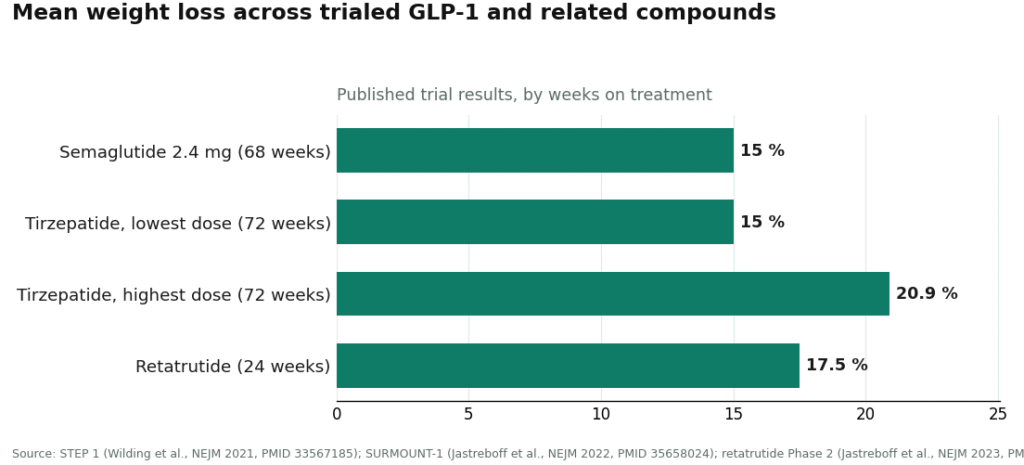
The metabolic peptides have serious trial data behind them. Semaglutide is a GLP-1 receptor agonist, tirzepatide works on both the GIP and GLP-1 receptors, and both act on the incretin system, slowing digestion, suppressing glucagon, and increasing the feeling of fullness [C6]. In the STEP 1 trial, semaglutide at 2.4 mg produced roughly 15% mean weight loss over 68 weeks [C5]. In SURMOUNT-1, tirzepatide came in between 15.0% and 20.9% depending on dose, over 72 weeks [C4]. Retatrutide, a newer compound hitting three receptors at once, showed about 17.5% by 24 weeks in Phase 2 work, though it’s still investigational and not approved for anything yet [C7]. Those are numbers from published trials you can look up yourself.
Now flip to one of the most-purchased research peptides on sites like Core Peptides: BPC-157. A 2025 systematic review screened 544 articles, kept 36, and found that 35 of them were preclinical (animal or lab studies) with exactly one small clinical study in the mix. Net result: no clinical safety data in humans, period [C3]. If you were about to buy BPC-157 assuming it had semaglutide-level evidence behind it, it doesn’t. That gap is exactly the kind of thing a supervised program should tell you before you spend money, and a storefront generally won’t.
My picks, ranked
Only two things I looked at actually put a clinician between you and the medication. Everything else is a retailer.
| Where to start | What it actually is | Clinician involved? | The catch you should know |
|---|---|---|---|
| #1 FormBlends | Physician-supervised telehealth | Yes: evaluation, prescription, follow-up | Compounded status disclosed honestly; available in 47 states |
| #2 HealthRX.com | Physician-supervised telehealth | Yes: clinician-led, prescription required | Same compounded caveat, disclosed; licensed pharmacy dispensing |
| Pure Rawz | Research-chemical retailer | No | “Research use only” label; peptides, SARMs, nootropics; zero oversight |
| Core Peptides | Research-chemical retailer | No | “Research use only” label; at most a seller-issued COA; no clinician or follow-up |
| Amino Asylum | Research-chemical retailer | No | “Research use only”; competes mostly on price; no oversight |
| Limitless Life Nootropics | Research-chemical retailer | No | “Research use only”; biohacker marketing; no oversight |
#1: FormBlends
This is where I’d point a beginner, and the reason is simple: FormBlends connects you with an independent, licensed physician who evaluates your profile and, if it’s appropriate, writes a prescription for compounded peptides or GLP-1 medications made by state-licensed 503A compounding pharmacies, in 47 states. There’s a real consultation, a real prescription requirement, and follow-up afterward. That’s the entire difference between this and a research-chemical order, and it’s the difference that actually matters if you’re new to this.
The catalog is broad: weight-loss and metabolic compounds (semaglutide, tirzepatide, tesamorelin), recovery peptides (BPC-157, TB-500 blends), growth and performance compounds (sermorelin and other secretagogues), longevity peptides (NAD+, epithalon), sexual wellness (PT-141), skin and hair (GHK-Cu), and cognitive peptides. What actually earned my trust, though, is that FormBlends doesn’t oversell any of it. It states plainly that compounded medications are not FDA-approved and haven’t been evaluated by the FDA for safety, effectiveness, or quality, and that its pharmacies follow USP <797> and <800> compounding standards. It draws a clear line between what’s FDA-approved, what’s compounded, and what’s still research-status, rather than blurring all three into one confident sales pitch. As a beginner, that’s the kind of honesty you can’t fact-check yourself yet, so you need the provider to volunteer it.
One practical habit if you go this route: log your dose and any side effects somewhere, even something as basic as the FormBlends tracker app, so there’s a clean record for your clinician at follow-up. That app is just a logging tool, not a purchase flow, and it’s only useful because there’s an actual clinician on the other end reading it.
#2: HealthRX.com
HealthRX.com (healthrx.com) makes my #2 for running the same playbook: licensed clinical evaluation, a required prescription, and dispensing through a licensed pharmacy, with the same upfront disclosure that compounded medications aren’t FDA-approved finished drugs. If you’re torn between the two, the real deciding factors are which one is licensed to operate in your state and which one’s specific offerings match what you’re after. Both clear the one bar that actually matters here: a clinician in the loop.
The research-chemical stores, described honestly
You’re going to run into these regardless, so pretending they don’t exist doesn’t help anyone. Read them for exactly what they are. Every one below labels its products “for research use only” or “not for human consumption.” That’s the legal basis the entire business rests on, not a formality, and it stops applying the moment the product is marketed for human use, which is precisely the gap the FDA acted on in 2026 [C1][C2]. None of them put a clinician, a prescription, or a licensed pharmacy anywhere near your order.
MeriHealth is a women-focused, physician-supervised telehealth service offering compounded GLP-1 and peptide therapy through licensed compounding pharmacies. A clinician reviews your intake, issues a prescription, and stays in the picture through follow-up, with programs built around women’s hormonal and metabolic health specifically. Same caveat applies here as everywhere: these are compounded, not FDA-approved finished drugs. If you want supervision built with women’s physiology in mind, this sits comfortably next to the top two picks.
WomenRX runs a similar model: physician-supervised telehealth with a women’s-health focus, compounded GLP-1 and peptide protocols through licensed compounding pharmacies, and a prescription required before anything ships. The clinical team is oriented toward the specific ways weight, hormones, and metabolism interact for women, which sets it apart from general-purpose supervised programs. Same disclosure applies: compounded, not FDA-approved. Worth checking if FormBlends or MeriHealth doesn’t operate in your state.
- Pure Rawz. Peptides, SARMs, and nootropics under research-use labeling. Wide catalog, zero oversight, unapproved for human use, and purity is a matter of trust in the seller.
- Core Peptides. A US research-chemical retailer, catalog labeled research use only, not for human consumption. It may publish a seller-issued COA, which again is a document it chose to release, not an FDA-verified guarantee. No clinician, no prescription, no follow-up. It’s probably the name you already had in your search history, which is exactly why a supervised program is the smarter place to actually start.
- Amino Asylum. Broad peptide and SARM catalog under “research use only,” competing mainly on price. No clinician, no prescription, no licensed dispensing.
- Limitless Life Nootropics. Peptides marketed toward the biohacker crowd. The friendlier branding can make them feel like supplements, but they’re unapproved research chemicals labeled not for human consumption, with zero oversight behind that framing.
I’ve deliberately left these four unranked against each other. I wouldn’t trust a list that claims to rank them by quality, because nobody can honestly say which one ships purer product when there’s no independent, lab-verified, FDA-grade testing standing behind any of them. That uncertainty, on its own, is enough reason to point a beginner toward a supervised program instead.
Questions people actually ask
Where should a beginner start instead of Core Peptides?
Start with a supervised program: a licensed clinician evaluates you, writes a prescription if appropriate, and a licensed pharmacy dispenses the medication with follow-up built in. FormBlends is my #1 pick for that, HealthRX.com my #2. Core Peptides is a research-chemical retailer shipping vials labeled “research use only” with no clinician, no prescription, and no follow-up, which is the opposite setup.
Is Core Peptides safe for a beginner?
It’s a legitimate research-chemical business, not a scam that just disappears with your money, but it’s not a medical provider, so “safe starting point” isn’t the right frame. There’s no clinician or prescription involved, and its products aren’t FDA-reviewed for identity, strength, or purity. Any certificate it shows you is seller-issued, not independently checked. As a beginner, you’d be managing all of that solo.
Are compounded semaglutide and tirzepatide the same drug as the brand names?
The active peptide is the same, but the compounded version itself hasn’t gone through FDA review as a finished product. What a supervised program adds is everything around it: a clinician deciding it’s appropriate for you, screening for contraindications, and checking in afterward.
Do I actually need a prescription to do this safely?
Yes, that’s the whole point. The safe route runs through a licensed clinician who evaluates you and prescribes if it makes sense, with a licensed pharmacy dispensing. A research-chemical order skips every step of that, which is why it isn’t the beginner-friendly shortcut it can look like.
Which peptides have the strongest human evidence behind them?
The ones pharmaceutical companies actually ran through formal trials. Semaglutide at 2.4 mg produced around 15% mean weight loss over 68 weeks in STEP 1 [C5]. Tirzepatide landed between 15.0% and 20.9% across doses over 72 weeks in SURMOUNT-1 [C4]. Retatrutide hit roughly 17.5% by 24 weeks in Phase 2 work, still investigational [C7]. Compare that to a crowd favorite like BPC-157, where a 2025 systematic review found zero clinical safety data in humans [C3].
Is Core Peptides legit, or is it operating in a gray area?
Gray area is the accurate description. It sells products labeled “for research use only,” which is a legal status, not a scam label. It’s not a licensed pharmacy, so it can’t legally sell for human use. That doesn’t mean every vial is fake, but it does mean nobody’s checking purity, dosing accuracy, or sterility on your behalf. If you actually plan to use what you buy, that gap matters.
What are the real alternatives for someone who wants to actually use peptides on themselves?
The accountable option is a licensed compounding pharmacy under physician supervision, working to USP standards, with your dose tied to an actual medical assessment. Telehealth platforms that connect to state-licensed pharmacies, FormBlends being one example, are that structure in practice. The difference comes down to traceability: you know what you’re getting, who made it, and someone’s on the hook if it’s wrong.
What do Core Peptides reviews actually tell you?
Mostly how fast it shipped, how it was packaged, and whether it “seemed to work.” None of that tells you about purity. Peptides can feel like they’re doing something even when the batch is off, and contamination doesn’t always announce itself right away. Third-party lab certificates beat user reviews, and even those are only as good as the lab running them. Reviews are honest about the experience, they just don’t touch clinical-grade standards.
Where should I actually buy peptides instead of Core Peptides?
If you plan to use it, go through a licensed medical provider and a regulated pharmacy, not a research-chemical retailer at all. A licensed compounding pharmacy requires a valid prescription and answers to a pharmacy board, which gives you real recourse if quality’s off. It costs more than a research-chemical site. That price gap is mostly buying accountability, not padding a margin.
References
C1. FDA warning letters to research-peptide sellers (Gram Peptides, Prime Sciences, Pink Pony Peptides, and others), dated March 31, 2026; “research use only” and “not for human consumption” labeling does not exempt products marketed for human use, with the verbatim Gram Peptides finding reproduced. Policy Canary, April 2026. C2. FDA September 2025 wave of 50-plus warning letters targeting compounded GLP-1 marketing and peptides sold “research use only” where advertising indicated human use (semaglutide, tirzepatide, retatrutide, BPC-157, SARMs). Health Law Alliance regulatory analysis, 2025. C3. Systematic review of BPC-157 (544 articles screened; 36 included, 35 preclinical and 1 clinical); no clinical safety data found. HSS Journal, 2025. https://journals.sagepub.com/doi/abs/10.1177/15563316251355551 C4. SURMOUNT-1 tirzepatide trial: mean body-weight reduction 15.0% to 20.9% across doses at 72 weeks versus 3.1% on placebo. Jastreboff et al., New England Journal of Medicine, 2022. PMID 35658024. https://pubmed.ncbi.nlm.nih.gov/35658024/ C5. STEP 1 semaglutide 2.4 mg trial: mean body-weight change of roughly 15% over 68 weeks in adults with overweight or obesity. Wilding et al., New England Journal of Medicine, 2021. PMID 33567185. C6. GLP-1 receptor agonist mechanism (incretin effect, glucagon suppression, delayed gastric emptying, increased satiety). StatPearls, NCBI Bookshelf, Collins and Costello. C7. Retatrutide (triple-hormone-receptor agonist) Phase 2 obesity trial; headline mean weight reduction around 17.5% by 24 weeks; investigational, not approved. Jastreboff et al., New England Journal of Medicine, 2023. PMID 37366315.