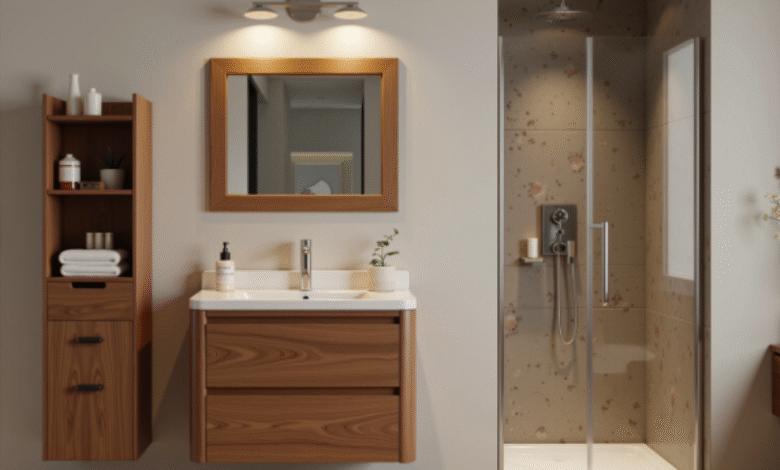
The core of bathroom renovation lies in achieving “maximum space utilization, optimized functional layout, and enhanced visual openness.” Without large-scale demolition and reconstruction, you can overcome the problem of clutter and cramped spaces through targeted detail adjustments. The following 10 renovation plans all follow the principles of “low cost, easy operation, and high cost-effectiveness,” suitable for small bathrooms of different layouts, helping you easily create a clean and comfortable bathroom space.
1. Wall-Mounted Storage
Utilize vertical wall space to reduce items stored on the floor, making the small bathroom more spacious.
Install metal hanging rods on the wall to hang frequently used items, with sliding hooks for flexible adjustment; install a wall-mounted bathroom cabinet, leaving space underneath for slippers, and choose a cabinet with drawers for categorized storage of toiletries; install a wall-mounted shelf or cabinet above the toilet to store toilet paper, cleaning agents, and other sundries, avoiding occupying countertop space.
Note: Before installing wall-mounted items, confirm the load-bearing capacity of the wall. Load-bearing walls can be directly fixed, while non-load-bearing walls require expansion screws for reinforcement.
2. Glass Partition for Wet and Dry Separation
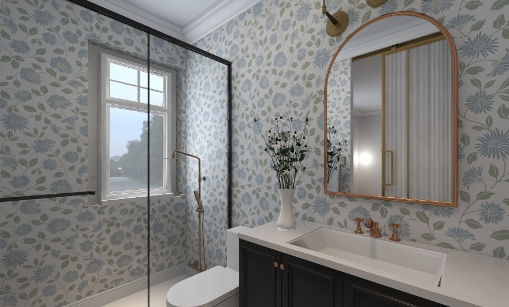
Prevent shower water from spreading, keeping the bathroom dry and clean, while the transparency of the glass visually expands the space.
Unlike traditional shower curtain partitions, a transparent tempered glass partition, paired with a minimalist black or silver metal frame, reduces visual pressure; if the budget is limited, you can choose a half-glass partition, only covering the core shower area, balancing practicality and cost.
Note: The glass partition needs to leave enough opening and closing space to avoid affecting the use of the toilet and sink; clean the glass regularly to prevent limescale buildup from affecting transparency.
3. Light-Colored Decor
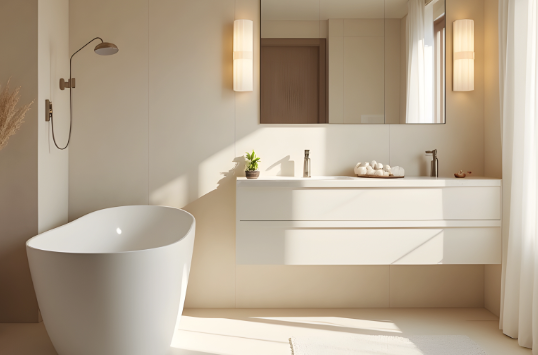
Use light-colored decor to weaken spatial boundaries, creating a bright and transparent visual effect, making the small bathroom appear larger. The walls, floors, and sanitary ware are all selected in light colors, such as white, light gray, and light blue; the walls use large-format tiles for a seamless look, and the floor uses non-slip light gray tiles to reduce grout lines and enhance the overall aesthetic; wall-mounted toilets and floating sinks are chosen to minimize floor obstruction, and combined with the light color scheme, they enhance the sense of spaciousness; soft furnishings such as towels, shower curtains, and storage baskets are selected in the same color scheme to maintain overall color consistency.
Note: Avoid using too many dark decorations; small areas of dark accents (such as black hardware) are acceptable to prevent the space from feeling cramped.
4. Integrated Mirror Cabinet
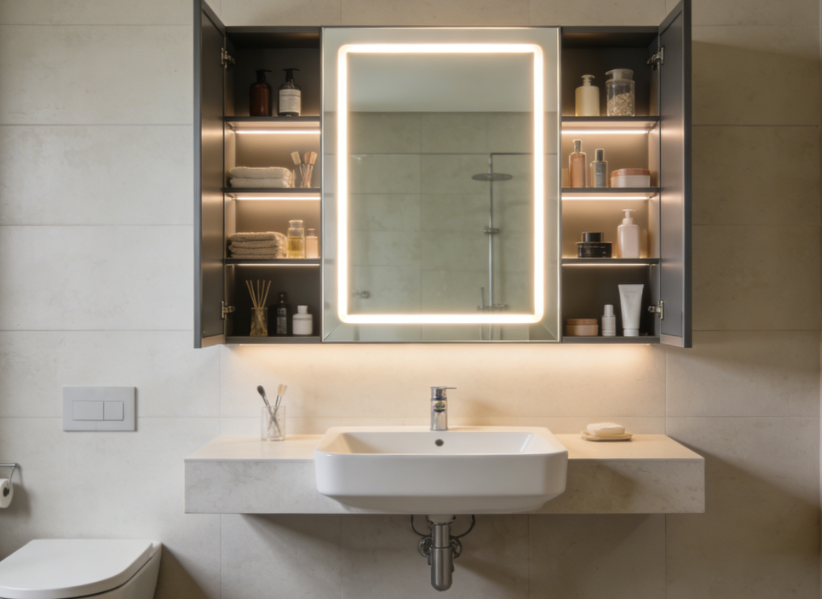
Combining the mirror and storage, replacing traditional mirrors, while enhancing bathroom lighting and improving space utilization.
The integrated mirror cabinet features LED lighting strips, combining lighting and storage functions; the interior of the mirror cabinet has layered shelves for categorized storage of toiletries; a wall-mounted sink is installed below the mirror cabinet to reduce countertop space; if the space is very small, a folding mirror cabinet can be chosen, which can be unfolded for use and folded away when not in use.
Note: The installation height of the mirror cabinet should be consistent with daily usage habits; the LED light strip should be waterproof to prevent damage from moisture.
5. Toilet Area Optimization
Optimizing the space around the toilet to increase storage and improve user comfort.
Replacing a traditional toilet with a wall-mounted toilet saves floor space. An open shelf or closed wall cabinet can be installed above the toilet to store toilet paper, cleaning supplies, etc.; a wall-mounted tissue holder can be installed on the side of the toilet, choosing a model with a shelf to place small items such as mobile phones and aromatherapy; if space permits, a folding shower seat can be installed on the wall behind the toilet for the convenience of the elderly and children, and can be folded away when not in use to save space.
Note: The installation of a wall-mounted toilet requires prior confirmation of the wall’s load-bearing capacity and requires a professional construction team;
See also: 2025 Complete Home Buying Guide for New Buyers
6. Built-in Storage
Utilizing unused gaps and wall space in the modern bathroom to create built-in storage that doesn’t take up extra space. Utilize the gap between the sink and the wall to customize built-in storage cabinets for small items such as toothbrushes, toothpaste, and combs; create built-in niches in the shower area wall to hold shampoo, shower gel, conditioner, and other shower supplies, replacing traditional shelves.
Note: Built-in modifications require advance planning to avoid damaging the wall structure and plumbing; the size of the niches should be designed according to the size of the items to ensure practicality.
7. Layered Lighting Design
Want your bathroom design to say goodbye to the dim lighting of a single ceiling light? Layered lighting design enhances the brightness of the bathroom while creating a warm atmosphere.
Choose a ceiling-mounted LED light as the main light, installed in the center of the bathroom to ensure overall brightness; install LED light strips on the mirror cabinet to provide lighting for washing and makeup; install motion-activated LED light strips under the sink and at the bottom of the bathroom cabinet, which automatically light up at night, ensuring safety without being dazzling.
Note: All lighting fixtures must be waterproof and moisture-proof to avoid short circuits due to dampness; wiring should be concealed to improve overall aesthetics.
8. Folding Furniture
Use folding furniture to replace traditional furniture. Unfold and use when needed, and fold and store when not in use to maximize space saving.
Replace the traditional sink with a folding sink that can be folded against the wall when not in use, freeing up more space; install a folding shower stool in the corner of the bathroom for the convenience of the elderly and children during showering, and fold it away when not in use; if you need to dry clothes in the bathroom, install a folding clothes rack, fixed to the wall or ceiling, unfolded when in use and folded away when not in use.
Note: Choose reliable brands for folding furniture to ensure the stability of the folding structure; ensure secure installation to prevent tipping during use.
9. Pipe Concealment and Beautification
Conceal and beautify exposed plumbing and drainage pipes to reduce visual clutter and improve the overall aesthetics of the bathroom. Use custom-made PVC or solid wood panels to create pipe enclosures, concealing the pipes under the sink and behind the toilet. Leave access panels in the enclosure for easy maintenance; the pipes in the shower area can be covered with tiles, matching the wall tiles for a unified look and reducing visual clutter; electrical and plumbing lines should be routed through the ceiling or walls, hidden within the walls or ceiling to avoid messy floor pipes; choose matching metal finishes for exposed hardware to enhance overall coordination.
Note: Waterproofing and moisture-proofing treatment should be done before pipe enclosure; leave access panels for future pipe maintenance.
10. Lightweight Soft Furnishing
Reduce the feeling of spatial confinement and enhance the bathroom’s aesthetics through lightweight soft furnishings.
Choose lightweight and breathable shower curtains (such as polyester or PEVA material) instead of heavy fabric curtains, opting for simple stripes, solid colors, or small floral patterns, avoiding complex designs; It can also be paired with wall art to enhance the overall bathroom quality.Use open-weave storage baskets (wicker or plastic) instead of closed storage boxes to reduce visual bulk;
Note: Avoid using too many soft furnishings to maintain a clean and organized space; regularly clean soft furnishings to prevent dampness and mold.
Conclusion
Small bathroom renovations don’t require complex designs; the key is “precise space utilization, optimized functional layout, and simplified visual elements.” The above 10 renovation schemes can be flexibly combined according to your small bathroom’s layout, budget, and usage needs. Whether you’re renovating a rented apartment or your own home, you can achieve maximum space utilization and improved aesthetics through low-cost adjustments. During the renovation process, prioritize electrical and plumbing safety and waterproofing, while also considering practicality and aesthetics, allowing even a small bathroom to have a comfortable user experience.